





Credo
15 June 2026
Naming is a powerful act. To assign a label to a concept is to shape how it is perceived. A name is hardly just a label; its linguistic associations influence how people think and behave. This principle extends to the naming of the biblical canon. Many people might be aware that Protestant Christians and Jews share a common text, yet the distinct names for the text reflect profound differences in theology and communal identity.
In the Protestant tradition, we call the first part of the Bible the “Old Testament.” The term was first coined by the early church father Melito of Sardis in the 2nd century CE. In contrast, Judaism refers to this collection as the “Tanach.” Tanach is an acronym formed from the first Hebrew letters of its three constituent parts: the Torah, which is conventionally attributed to Moses; the Neviim, the prophets; and the Ketuvim, the writings.
The tripartite division of the Jewish Tanach can be traced back to many ancient resources dating to the 2nd century BCE. Among them, the most familiar reference for Christians may be Luke 24:44:
[Jesus] said to [the disciples], “This is what I told you while I was still with you: Everything must be fulfilled that is written about me in the law of Moses, the Prophets, and the Psalms.” (NIV)
As the main book of the Ketuvim (the writings), the Psalms here represent the third division. This statement not only acknowledges the Jewish structure of scripture, more importantly, it presents Jesus as the fulfillment of it all. This verse ultimately invites a Christ-centered reading of Scripture that would dominate the Christian understanding of the Bible as a whole.
Having considered the history of naming, we now turn to the arrangement of the books themselves. The sequence and organization of the texts reveal the distinct ideologies in identity formation of each community.
In the following list, we can observe that both the Tanach and the Old Testament place the Mosaic laws in the beginning of the canon. Yet what follows the laws and how the canon concludes look drastically different.
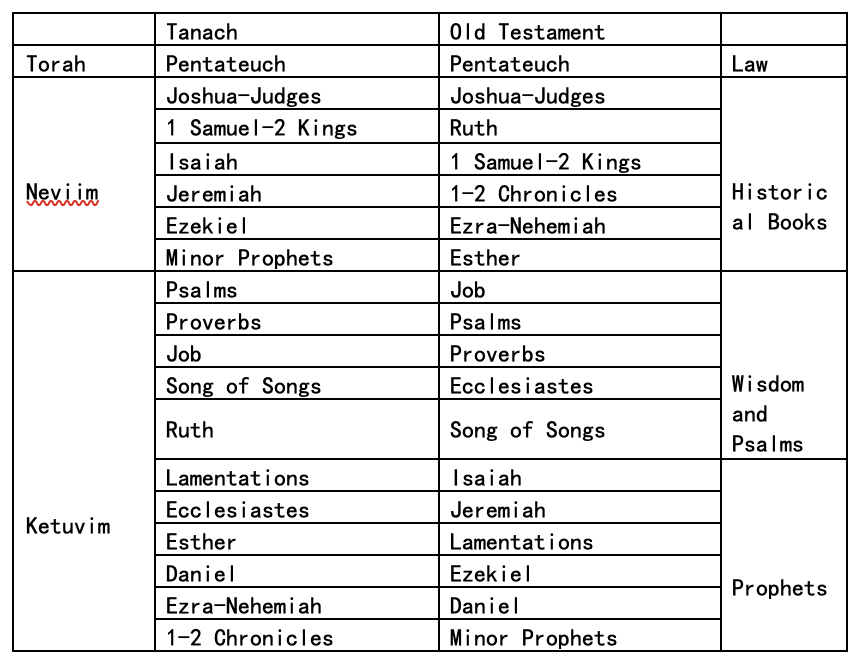
Here we’ll use the ending of each canon as a case study to show the different theologies implied in the arrangement.
The Jewish Tanach concludes with 2 Chronicles. The final verses usher in the start of the Persian era in the land of Judea:
In the first year of Cyrus king of Persia, in order to fulfill the word of the Lord spoken by Jeremiah, the Lord moved the heart of Cyrus king of Persia to make a proclamation throughout his realm and also put it in writing:
“This is what Cyrus king of Persia says:
The Lord, the God of heaven, has given me all the kingdoms of the earth and he has appointed me to build a temple for him at Jerusalem in Judah. Any of his people among you may go up, and may the Lord their God be with them.” (2 Chron 36:22-23 NIV)
This ending is significant for three reasons. First, the decree of Cyrus marks the end of the Babylonian exile and the start of the reconstruction of the Temple. Second, the final word in the Hebrew text is alah (עלה), which means “go up”). This verb implies a geographical ascent to Jerusalem, echoing the Song of Ascent in the Psalms (120-134). This motion of going up also has spiritual significance—it points to a spiritual return and restoration for the exiles. Third, the focus on the Temple highlights the Jewish emphasis on sacred place, worship, and God’s copresence with His chosen people.
On the other hand, the Christian Old Testament ends with the prophecy of Malachi:
See, I will send the prophet Elijah to you before that great and dreadful day of the Lord comes. He will turn the hearts of parents to their children, and the children to their parents; or else I will come and strike the land with total destruction. (Mal 4:5-6 NIV)
This ending here establishes a different theological framework. First, these verses indicate a prophetic expectation. It is open-ended and invites the fulfillment of the prophecy. Second, this prophetic language directly paves the way for the New Testament. Matthew’s gospel identifies John the Baptist as the Elijah figure who fulfills this very role. Third, the paradigm of prophecy and fulfillment highlights the theology of redemption in Christian interpretation. This model has profoundly shaped Christian interpretation of the Old Testament in history.
As we compare the different endings between the Jewish Tanach and Christian Old Testament, we can observe the distinct theological tendencies in the two communities. In the Jewish tradition, the emphasis on the temple expresses their deepest desire for the restoration of the sacred place and continuity as God’s elected people. As for the Christian tradition, the ending of a prophecy constructs a Christ-centered interpretive framework that underscores the importance of the Messiah and God’s ultimate fulfillment.
From naming to the arrangement of books in the same text, the differences between the Jewish Tanach and the Christian Old Testament demonstrate that the same text can be read through different interpretive lenses. The unique theological frameworks and interpretive strategies each tradition employs continue to generate new possibilities of reading of the shared text, both throughout history and today.
 Dr Sun Jiani is lecturer in the Old Testament at Biblical Graduate School of Theology.